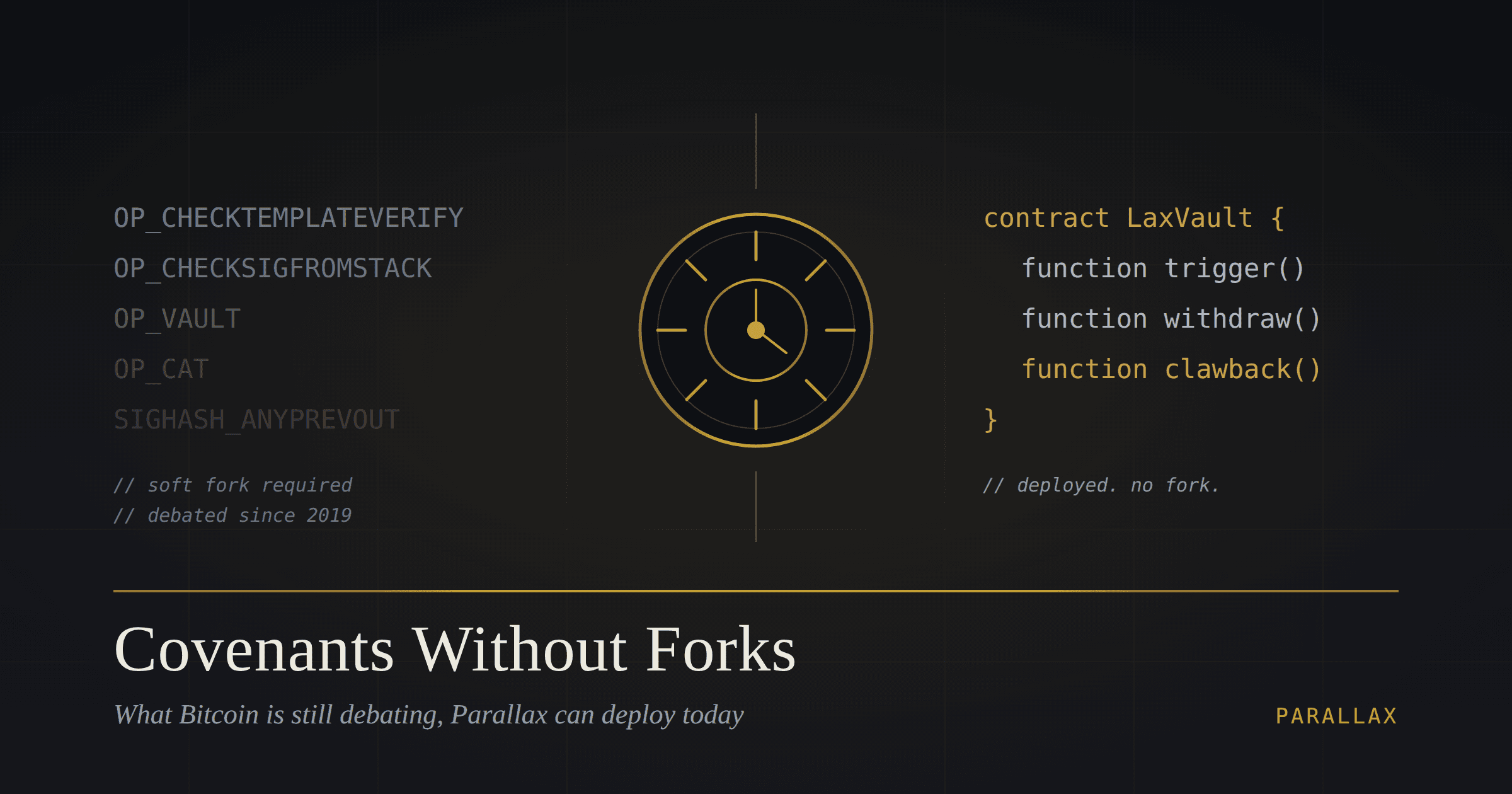
Since 2019, Bitcoin has debated whether to enable a class of functionality called covenants. The debate is genuinely hard, because on Bitcoin, enabling covenants means changing consensus rules — a soft fork, with all the coordination cost, political friction, and irreversibility that implies. On Parallax, the same functionality is a contract deployment. No fork, no client update, no signaling period. This post explains what covenants are, walks through the major Bitcoin proposals, shows how each one maps to something you can already build on Parallax, and sets out what that trade-off costs.
What a covenant is
Bitcoin Script today answers one question: is this spend authorized? Signatures, timelocks, hashlocks — all of it gates permission. Once the conditions are met, the coins can go anywhere. A covenant adds a second question: where are these coins allowed to go? A covenant-encumbered output can restrict the outputs of the transaction that spends it — "these coins may only move to this recovery address," or "this spend must match this exact template." That one capability unlocks vaults, payment pools, congestion control, non-interactive channels, and most of the Layer 2 designs Bitcoin developers have sketched over the last decade. Which is exactly why the debate is so heated: the upside is large, and so is the surface area of a mistake baked into consensus forever.
The proposals, and their Parallax equivalents
OP_CHECKTEMPLATEVERIFY (BIP-119). CTV lets an output commit to the exact transaction that spends it. Use cases: congestion control trees, vault constructions, payment pools. On Parallax, a contract that only releases funds to hardcoded destinations and amounts is a few dozen lines of Solidity. Committing to a fixed set of outputs is the simplest thing contract logic can express.
OP_CHECKSIGFROMSTACK (BIP-348). CSFS verifies a signature over an
arbitrary message, not just the spending transaction. It enables delegation and
oracle-signed conditions. The EVM has shipped this since 2015 as the
ecrecover precompile. Every oracle design, every signed-message authorization
pattern, every meta-transaction relies on it daily.
OP_CAT (BIP-347) and transaction introspection. Restoring CAT would let Bitcoin Script carry state across spends and inspect the spending transaction — clever, constrained, and the subject of enormous research effort. Contracts have persistent storage and full environmental introspection natively; what Script reaches for through construction, the EVM provides directly.
SIGHASH_ANYPREVOUT (BIP-118) and Eltoo. APO enables rebindable signatures, the missing piece for LN-Symmetry — payment channels where only the latest state matters and toxic old states disappear. Contract-based channels with monotonic state numbers and challenge periods achieve the same property, and it's how every EVM state channel and rollup fraud-proof system already works.
OP_VAULT (BIP-345). The most user-facing proposal: reactive self-custody. Coins in a vault can only be withdrawn through a trigger transaction that starts a visible delay window, during which the owner can sweep everything to a pre-committed recovery path if the withdrawal wasn't theirs. Bitcoin needs a new opcode plus CTV to express that pattern. On Parallax it is an ordinary contract — trigger, timelocked withdrawal, always-available clawback, watchtower-friendly events — and deploying it immutably makes the rules as fixed as an opcode's.
Drivechains (BIPs 300/301). Two-way pegged sidechains require miners to validate withdrawal bundles — a consensus change Bitcoin has debated since 2015. On an EVM chain, a bridge is a contract, and its security model is a design choice: multisig, light-client verification, or ZK proofs, upgradeable in the open as the state of the art improves.
OP_CHECKCONTRACTVERIFY (BIP-443). The MATT proposal: carrying merkleized state in UTXOs and settling disputes with fraud proofs. It arrives at commitments to contract state and fraud-proof dispute resolution — the same ground the account model covers by construction, reached from the other side.
What doesn't map
Not everything on Bitcoin's wishlist is a contract away. Changes to the signature schemes themselves — say, post-quantum verification — require a precompile, which is a fork on Parallax just as it is on Bitcoin. Mempool policy, block structure, and mining-layer changes live below the contract layer on any chain. Covenants are the special case where Bitcoin's constraint is script expressiveness, and script expressiveness is exactly what an EVM provides.
The trade
Bitcoin's script restrictions are deliberate. A minimal consensus surface is easier to audit exhaustively, harder to exploit, and slower to ossify around a mistake. When Bitcoin finally ships a covenant opcode, every full node on Earth will enforce it on native coins with a specification small enough to hold in your head. That is a real property, and Bitcoin's caution is the reason it has it.
Parallax made the opposite bet on the execution layer: we accept the EVM's larger surface in exchange for expressiveness, while keeping Bitcoin's monetary and consensus discipline — proof of work, a 21M cap, a fair launch, ten-minute blocks. Contract-layer enforcement is consensus enforcement too; the EVM is our consensus. But the failure modes are not symmetric: a flaw in a consensus rule is a chain-wide event that everyone notices and coordinates around, while a flaw in a contract is a silent, permanent loss for whoever trusted it, with no fork to coordinate a fix. That is the cost of moving expressiveness up the stack, and it is why a custody contract should be immutable and adversarially reviewed before it holds anything. The verification effort does not disappear. It moves from the fork-coordination layer to the contract layer. What that buys is a chain where the last decade of Bitcoin's Layer 2 research — vaults, pools, channels, covenant-based custody — is available to build against today, and where arguing about whether one of those designs should exist is an argument about a particular contract rather than about consensus itself.
References
- BIP-119: OP_CHECKTEMPLATEVERIFY — Jeremy Rubin, 2019
- BIP-348: OP_CHECKSIGFROMSTACK — Brandon Black, Jeremy Rubin, 2024
- BIP-347: OP_CAT in Tapscript — Ethan Heilman, Armin Sabouri
- BIP-118: SIGHASH_ANYPREVOUT — Christian Decker, Anthony Towns
- eltoo: A Simple Layer2 Protocol for Bitcoin — Decker, Russell, Osuntokun, 2018
- BIP-345: OP_VAULT — James O'Beirne, Greg Sanders, Anthony Towns
- BIP-300 / BIP-301: Drivechains — Paul Sztorc, CryptAxe
- BIP-443: OP_CHECKCONTRACTVERIFY — Salvatore Ingala (the MATT proposal)
- Bitcoin Covenants — Möser, Eyal, Sirer, 2016 — the paper that named the concept
- ecrecover precompile — Ethereum Yellow Paper, Appendix E